How one man’s later crime can cast a shadow over people still fighting to prove their innocence.
Monday, 19 October 2026
I’m still waiting for a reply from the Single Justice Service.
At this point, waiting has become something of a recurring theme in my dealings with the justice system.
I’ve made enquiries, obtained account references and supplied information in an attempt to establish the details of historical court proceedings associated with my name.
And now I wait.
There’s only so much time you can spend checking for an email that hasn’t arrived, so I did what any sensible person might do.
I started scrolling through YouTube.
Somewhere between the usual recommendations, I came across the case of a man called Shaurn Thomas.
And what began as a little casual viewing turned into something considerably more troubling.
Because I’ve also been thinking about cases here in Britain involving prisoners whose convictions I believe deserve serious reconsideration.
People who maintain their innocence.
People who may have spent years trying to get somebody to listen.
People who, if their convictions are eventually overturned, might simply want to go home and get on with whatever remains of their lives.
And I couldn’t help wondering whether a case like Thomas’s, even on the other side of the Atlantic Ocean, could make that struggle more difficult.
Not necessarily through any change in the law.
But through something much harder to measure.
Public confidence.
1. Shaurn Thomas: The First Murder Conviction
In November 1990, a Philadelphia businessman named Domingo Martinez was murdered during a robbery.
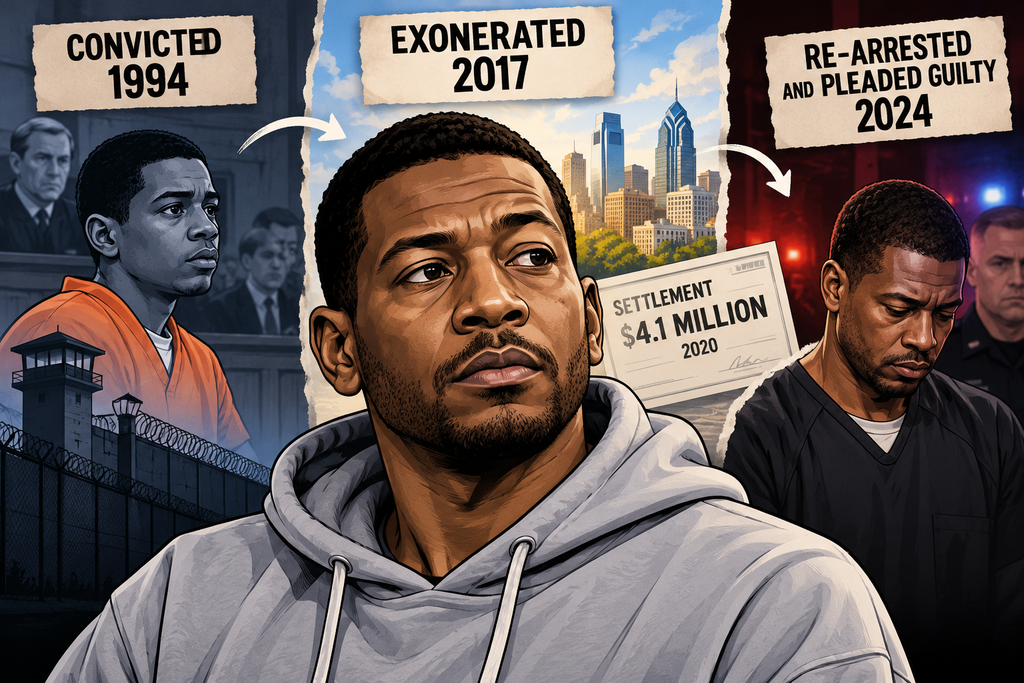
Shaurn Thomas, who was sixteen at the time of the killing, was eventually convicted in connection with the crime.
In 1994, he received a life sentence.
Thomas maintained that he had not committed the murder.
He said he had been at a juvenile detention facility at the relevant time, following his arrest in connection with an unrelated incident.
That was an alibi which, if properly established, could have fundamentally changed the case against him.
But his conviction stood.
For years.
Then decades.
Eventually, lawyers working with the Pennsylvania Innocence Project began examining the case.
They uncovered serious problems, including evidence relevant to Thomas’s alibi and concerns about the testimony used against him.
In 2017, his conviction was overturned and the prosecution subsequently dismissed the charges.
Thomas walked free after approximately twenty-four years in prison.
It was the kind of case that demonstrates why post-conviction review matters.
The original verdict had been reached.
The appeals process had failed to correct it for years.
But further investigation eventually exposed sufficient problems for the conviction to be set aside.
Philadelphia later settled Thomas’s civil lawsuit for approximately $4.1 million.
For somebody who had lost so much of his adult life to imprisonment, there was finally an opportunity to start again.
Or so it appeared.
2. The Second Murder
In January 2023, a man named Akeem Edwards was shot and killed in Philadelphia.
He was thirty-eight years old.
Thomas was subsequently charged in connection with his death.
And in December 2024, Thomas pleaded guilty to third-degree murder and related offences.
According to the prosecution’s account, the killing arose from a dispute over a $1,200 drug debt.
The contrast was extraordinary.
A man whose previous murder conviction had been overturned, who had received millions of dollars in compensation and whose release had been associated with the work of innocence campaigners, had admitted responsibility for killing another person.
It is a deeply disturbing story.
And we shouldn’t allow the controversy surrounding Thomas to obscure the person who died.
Akeem Edwards had a family.
He had people who loved him.
His death was not merely an unfortunate complication in somebody else’s narrative of exoneration.
It was a murder, and Thomas admitted his guilt.
But the story also creates an uncomfortable question.
What happens when somebody who has been recognised as wrongfully convicted subsequently commits a serious crime?
Does it change how we think about the original case?
And, perhaps more importantly, does it change how we think about everybody else who says they’ve been wrongly convicted?
3. Two Crimes, Two Separate Questions
This is where I think we need to be particularly careful.
Thomas’s guilty plea in the killing of Akeem Edwards does not establish that he committed the murder of Domingo Martinez in 1990.
Those are two different crimes.
They involved different victims, different evidence and different proceedings.
The fact that somebody commits a crime in 2023 cannot, by itself, prove what they did or did not do in 1990.
It might affect how people perceive their character.
It might influence public opinion.
But it does not repair the evidential problems that caused the earlier conviction to be overturned.
There is also a distinction between overturning a conviction and conclusively proving every detail of a person’s innocence.
Thomas’s original case involved serious concerns about the reliability of the conviction. Prosecutors agreed it should be vacated and declined to retry him, although they did not claim every question about the original killing had been definitively answered.
Those distinctions matter.
The justice system should not require us to decide whether somebody is a good person before examining whether their conviction is safe.
Nor should a later crime automatically validate an earlier prosecution.
A conviction has to stand or fall on the evidence relevant to that conviction.
Anything else risks turning justice into a character assessment conducted with hindsight.
4. The Problem for People Still Claiming Innocence
This is the part of the story that concerns me most.
Imagine somebody sitting in a British prison today.
They maintain that they didn’t commit the crime for which they were convicted.
Perhaps they have been trying for years to obtain a review.
Perhaps there are concerns about forensic evidence, witness testimony, disclosure failures or the way their trial was conducted.
Perhaps those concerns are well founded.
Perhaps they aren’t.
The point is that they deserve to be examined on their merits.
Now imagine a member of the public reading about Shaurn Thomas.
They see that he was released after a murder conviction was overturned.
They see that he received millions of dollars.
And then they see that he subsequently admitted to another murder.
It’s not difficult to imagine the reaction.
So much for exoneration.
They let him out, gave him millions, and look what happened.
That reaction is understandable at an emotional level.
But it becomes dangerous when it turns into a general assumption about other cases.
Because the next person seeking exoneration is not Shaurn Thomas.
Their evidence is not his evidence.
Their conviction is not his conviction.
And their future conduct cannot be predicted simply by looking at what another person did after release.
I cannot establish that Thomas’s case has caused any particular British appeal to fail or any specific innocence campaign to lose support.
That would require evidence I don’t have.
But I do worry about the possibility that high-profile stories like this influence the atmosphere in which other claims are heard.
Not necessarily in a courtroom.
Perhaps in the press.
Perhaps among potential supporters.
Perhaps in the minds of people deciding whether a prisoner deserves another chance to have their evidence examined.
And perhaps even in the willingness of ordinary people to believe that miscarriages of justice happen at all.
5. Britain Has Its Own Reasons to Take Wrongful Convictions Seriously
We don’t need to look to America to find examples of serious failures in criminal justice.
Consider the case of Rachel Manning, who was murdered in Milton Keynes in December 2000.
Barri White was convicted of her murder, while Keith Hyatt was convicted of perverting the course of justice.
Both convictions were eventually quashed.
White was acquitted at a retrial in 2008.
In 2013, Shahidul Ahmed was convicted of Rachel Manning’s murder.
The original investigation and prosecution had relied in part on forensic interpretations that later came under serious challenge.
It’s an example of how a conviction can appear secure until somebody examines the assumptions beneath the evidence.
And it reminds us why a criminal justice system needs mechanisms for correcting mistakes.
I have been thinking about cases like this, and about other prisoners in Britain whose claims of innocence I find troubling.
But I also recognise the limits of what I can know from documentaries, published reports and material available to the public.
Believing that a conviction may be unsafe is not the same thing as proving that the person convicted is innocent.
That’s precisely why proper investigation matters.
We should be neither automatically credulous nor automatically dismissive.
We should examine the evidence.
And if the evidence reveals a serious problem, we should be prepared to reconsider the verdict.
Even when doing so is uncomfortable.
6. Exoneration Is Not a Certificate of Good Character
Perhaps this is the most important distinction in the entire story.
When somebody’s conviction is overturned, the legal system is addressing a particular prosecution.
It is not issuing a guarantee that the person will never commit a crime.
It is not declaring that they possess exceptional moral character.
And it is certainly not promising that the rest of their life will be free from mistakes.
People who have been wrongfully convicted are still people.
Some will rebuild their lives successfully.
Some will struggle.
Some may commit offences later.
None of those possibilities makes it acceptable to imprison someone for a crime that has not been properly proved against them.
We should also be cautious about explaining Thomas’s later actions.
His lawyers pointed to the effects of prolonged imprisonment and the difficulties of adjusting to life after release.
Those difficulties are real concerns for people leaving prison after many years.
But we cannot simply assume that his wrongful imprisonment caused him to kill Akeem Edwards.
An explanation requires evidence.
And even a credible explanation would not erase responsibility for the killing.
We can acknowledge the damage done by an unsafe conviction while also recognising the harm a person subsequently causes.
Both things can be true.
7. The Unfair Burden of Being the Perfect Exoneree
There’s another problem here.
When somebody is released after a wrongful conviction, we often expect a particular sort of story.
The person emerges from prison.
They embrace their family.
They express gratitude to their lawyers.
They begin rebuilding their life.
Perhaps they become an advocate for criminal justice reform.
It’s a story that audiences understand.
And when it happens, it’s genuinely encouraging.
But what happens when the person doesn’t fit that narrative?
What if they are angry?
What if they struggle with relationships?
What if they find ordinary life difficult?
What if they make poor decisions?
We shouldn’t confuse the moral appeal of an exoneration story with the legal basis for overturning a conviction.
A person doesn’t have to become an inspirational public speaker to deserve freedom from an unsafe conviction.
They don’t have to be likeable.
They don’t have to be articulate.
They don’t even have to be somebody we’d particularly want to spend time with.
They have to be entitled, under the law and the evidence, to the remedy they seek.
That is a much less romantic standard.
But it’s a much more important one.
8. Meanwhile, I’m Still Waiting for an Email
My own dealings with the justice system are obviously very different from the cases I’ve been discussing.
I’m not comparing an administrative enquiry about historical court records with spending decades in prison for murder.
The stakes are not remotely the same.
But these experiences have made me think more carefully about how difficult it can be to challenge or even understand what a legal system has done.
Sometimes the first obstacle isn’t persuading somebody that a decision was wrong.
It’s finding the records.
Establishing which court dealt with the matter.
Identifying the relevant proceedings.
Working out who has the authority to provide an answer.
And then waiting for that answer to arrive.
If navigating a relatively limited enquiry can become complicated, I can only imagine the persistence required to challenge a serious conviction after years in prison.
Of course, imagination is not evidence.
But it is a reason to take the problem seriously.
For somebody who maintains their innocence, delay is not merely an administrative inconvenience.
It can mean another birthday in prison.
Another Christmas.
Another year in which their family grows older while they remain behind bars.
And if their conviction is eventually overturned, no compensation can give them those years back.
They may not want to become a public symbol.
They may not want to campaign for the rest of their lives.
They may simply want to go home.
9. When Exoneration Backfires
So does the Shaurn Thomas case mean exoneration has backfired?
Not in the sense that his later crime makes the earlier conviction valid.
It doesn’t.
And not in the sense that we have established a measurable negative effect on other prisoners seeking to overturn their convictions.
We haven’t.
But it does present a risk.
When one person’s story becomes highly visible, it can start to stand in for a much larger group of people who have nothing to do with that person’s actions.
One former prisoner’s later crime can become a convenient argument against trusting anybody who claims to have been wrongfully convicted.
And that’s a mistake.
The legal system should be capable of correcting an unsafe conviction without demanding a guarantee about the person’s future behaviour.
It should also be capable of holding that same person accountable if they later commit another crime.
Those responsibilities are not contradictory.
They are both part of administering justice.
Akeem Edwards deserved justice for his murder.
Domingo Martinez deserved a reliable investigation into his.
And people still imprisoned under convictions that may be unsafe deserve a fair opportunity to have their cases examined.
None of those obligations cancels out the others.
Conclusion: Innocence Is Not a Group Membership
I started today waiting for a reply from the Single Justice Service.
I ended up thinking about a murder case in Philadelphia, the British appeals system and people who may still be sitting in prison for crimes they didn’t commit.
That’s quite a journey for an afternoon spent scrolling through YouTube.
But perhaps it comes down to one simple principle.
Every conviction should be judged on its own evidence.
We shouldn’t preserve an unsafe conviction because somebody else, somewhere else, committed a crime after being released.
We shouldn’t ignore a murder because the person responsible was previously wrongfully convicted.
And we shouldn’t require people seeking exoneration to carry the burden of proving that every other exoneree will behave well for the rest of their lives.
Shaurn Thomas is responsible for his own actions.
Other prisoners are not responsible for his.
And the people who genuinely have been wrongfully convicted shouldn’t have to wait for the world to find a perfect exoneree before taking their claims seriously.
An exoneration is not a promise about the future. It is an obligation to confront the past.
Leave a Reply